
Oxford Poverty & Human Development Initiative

Oxford Department of International Development

Queen Elizabeth House, University of Oxford

Multidimensional Poverty Index

OPHI and the UNDP Human Development Report launch the Multidimensional Poverty Index or MPI – an innovative new measure that gives a vivid “multidimensional” picture of people living in poverty. The MPI will be featured in the 20th Anniversary edition of the UNDP Human Development Report and complements income by reflecting a range of deprivations that afflict a person’s life at the same time. The measure assesses the nature and intensity of poverty at the individual level in education, health outcomes, and standard of living.  OPHI has just concluded a first ever estimate and analysis of global multidimensional poverty across 104 developing countries, and is releasing these results in advance of the Report’s October publication. (Continued below map).

Get Adobe Flash player

Click here to see full size map

Explore global multidimensional poverty using OPHI’s interactive world map

Browse the MPI map and graphs by clicking on the different indicators shown in the top left menu and then hovering over different countries. Scroll down the top left menu of the map to reveal more data. Click on a specific data bar to reveal its description. Explore the map by region using the ‘World Map’ menu. Explore the data through different charts by scrolling over and clicking the different options in the top right box above the map.

What is the MPI?

The lives of people living in poverty are affected by more than just their income. The Multidimensional Poverty Index (MPI) complements a traditional focus on income to reflect the deprivations that a poor person faces all at once with respect to education, health and living standard. It assesses poverty at the individual level, with poor persons being those who are multiply deprived, and the extent of their poverty being measured by the range of their deprivations.

The MPI can be used to create a vivid picture of people living in poverty, both across countries, regions and the world and within countries by ethnic group, urban/rural location, or other key household characteristics. It is the first international measure of its kind, and offers an essential complement to income poverty measures because it measures deprivations directly. The MPI can be used as an analytical tool to identify the most vulnerable people, show aspects in which they are deprived and help to reveal the interconnections among deprivations. This enables policy makers to target resources and design policies more effectively. Other dimensions of interest, such as work, safety, and empowerment, could be incorporated into the MPI in the future as data become available.

The MPI reports acute poverty for 104 developing countries, which are home to 78% of the world’s people.

What does the MPI measure?

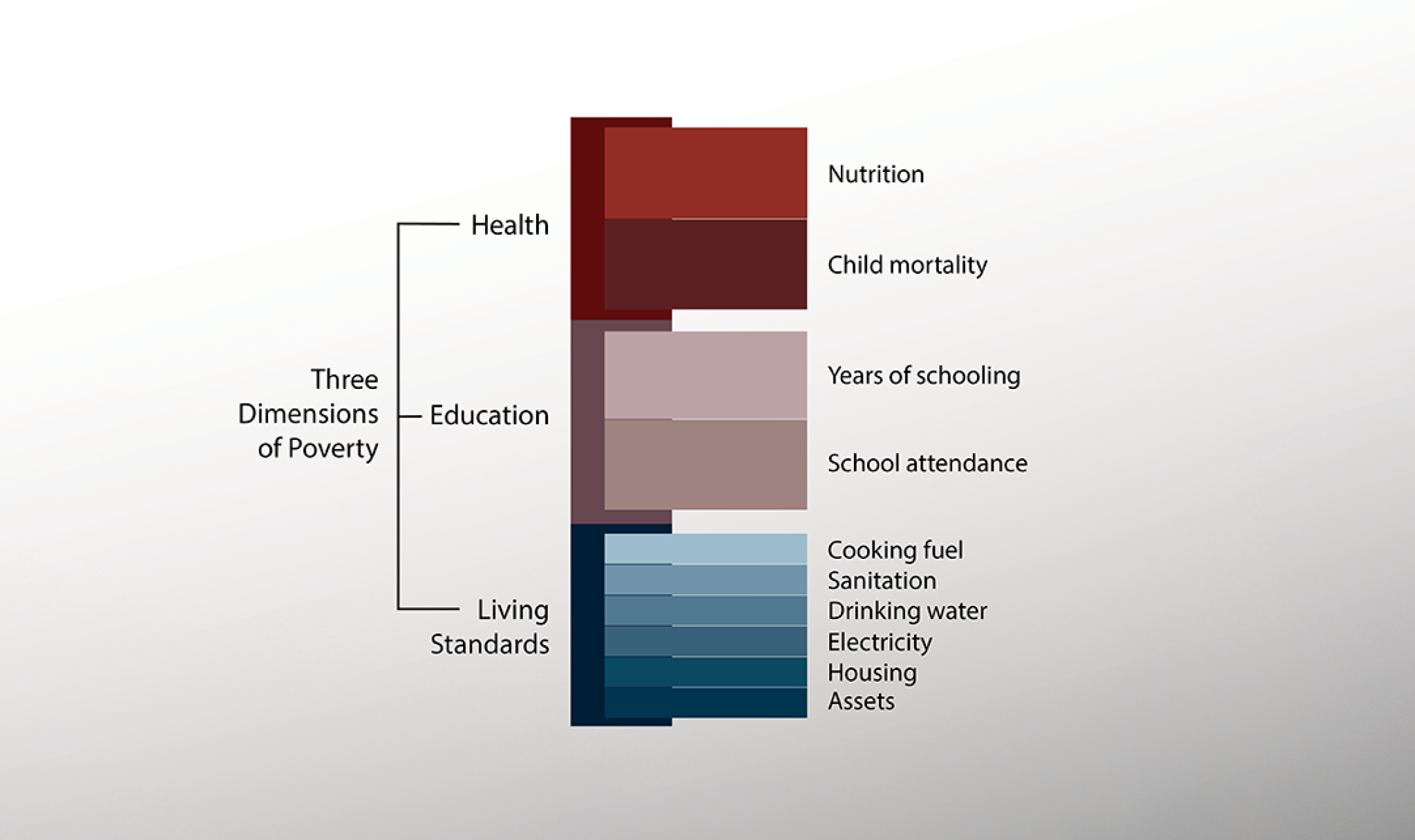
The MPI uses 10 indicators to measure three critical dimensions of poverty at the household level: education, health and living standard in 104 developing countries. These directly measured deprivations in health and educational outcomes as well as key services such as water, sanitation, and electricity reveal not only how many people are poor but also the composition of their poverty. The MPI also reflects the intensity of poverty – the sum of weighted deprivations that each household faces at the same time. A person who is deprived in 70% of the indicators is clearly worse off than someone who is deprived in 40% of the indicators.

Why is the MPI useful?

The MPI is a high resolution lens on poverty – it shows the nature of poverty better than income alone. Knowing not just who is poor but how they are poor is essential for effective human development programs and policies. This straightforward yet rigorous index allows governments and other policymakers to understand the various sources of poverty for a region, population group, or nation and target their human development plans accordingly. The index can also be used to show shifts in the composition of poverty over time so that progress, or the lack of it, can be monitored.

The MPI goes beyond previous international measures of poverty to:

  • Show all the deprivations that impact someone’s life at the same time – so it can inform a holistic response.
  • Identify the poorest people. Such information is vital to target people living in poverty so they benefit from key interventions.
  • Show which deprivations are most common in different regions and among different groups, so that resources can be allocated and policies designed to address their particular needs.
  • Reflect the results of effective policy interventions quickly. Because the MPI measures outcomes directly, it will immediately reflect changes such as school enrolment, whereas it can take time for this to affect income.
  • Integrate many different aspects of poverty related to the MDGs into a single measure, reflecting interconnections among deprivations and helping to identify poverty traps.

Who can use the MPI?

  • Governments
  • Non-Governmental Organisations
  • Private Sector institutions
  • Civil Society groups and Advocacy groups

How was the MPI created?

The MPI was created using a technique developed by Sabina Alkire and James Foster. The Alkire Foster method measures outcomes at the individual level (person or household) against multiple criteria (dimensions and indicators). The method is flexible and can be used with different dimensions and indicators to create measures specific to different societies and situations. For example, it can be applied to measure poverty or wellbeing, target services or conditional cash transfers and for monitoring and evaluation of programmes. The method can show the incidence, intensity and depth of poverty, as well as inequality among the poor, depending on the type of data available to create the measure. Read our policy page for more information on the method and the countries that have adopted it.

The specific indicators, cutoffs and weights employed by the MPI were chosen in a long process of consultation, study and fieldwork. The MPI indicators are the best combination possible to compare the 104 countries, given currently available data, and resonate with the Millennium Development Goals.

What next?

  • National measures: Governments can tailor the MPI to the indicators and cutoffs that are most appropriate in their country and use it to complement income poverty.
  • NGOs and Private Sector: These institutions can adapt the MPI to their context and use it for monitoring and accounting for the impacts of their work.
  • Targetting: Programmes that are targeting conditional cash transfers, or other social programmes can adapt the MPI to identify the people whose poverty is most intense, so the programmes reach them first.
  • More and better data: The MPI is restricted because we do not have internationally comparable data from the same surveys for other dimensions that might be useful such as safety from violence, work, the environment, empowerment, social relationships, and culture.

Read more about the new tool on our MPI Resources page.

Data citation

Please cite the MPI data as: Alkire, Sabina and Maria Emma Santos. 2010. Multidimensional Poverty Index: 2010 Data. Oxford Poverty and Human Development Initiative. Available at: www.ophi.org.uk/policy/multidimensional-poverty-index/.

MPI and MPI interactive map

OPHI gratefully acknowledges the financial support of the United Nations Development Programme (UNDP) Human Development Report Office, the International Development Research Centre (IDRC) of Canada, and Global Giving in creating the MPI.

OPHI’s interactive MPI map was created using StatPlanet software developed by Frank van Cappell. (Frank van Cappelle (2009) StatPlanet: Interactive Data Visualization and Mapping Software, Southern and Eastern Africa Consortium for Monitoring Educational Quality, Paris. http://www.sacmeq.org/statplanet).

Share and Enjoy:
  • Print this article!
  • Digg
  • Sphinn
  • del.icio.us
  • Facebook
  • Mixx
  • Google Bookmarks
 |  Trackback

Join OPHI Mailing List

Email address:     

Latest

Measure of deprivation ~ The Kathmandu Post Oped on the Multidimensional Poverty Index, recently launched by OPHI and the UNDP Human Development Report, and poverty in Nepal. Read article. Share and Enjoy: Read more

The Times of India India's Minister of state for planning V. Narayanasamy notes the number of multidimensionally poor people in eight Indian States Read more

A new and more exact yardstick ~ Kuensel Newspaper “We now have more data than we ever had before, so were able to do the multi dimensional poverty measure, which looks at every individual person, and the deprivations that batter their life at the same time,” said Dr Sabina Alkire, Director of OPHI Read more

Bhutan to adopt more inclusive poverty index ~ Bhutan Observer Article on the Multidimensional Poverty Index recently launched by OPHI and the UNDP Human Development Report Read more

Acute Multidimensional Poverty: A New Index for Developing Countries This paper presents a new Multidimensional Poverty Index (MPI) for 104 developing countries. It is the first time multidimensional poverty is estimated using micro datasets (household surveys) for such a large number of countries Read more

Highlighted Events

OPHI Summer School on Capability and Multidimensional Poverty 2010 on 11 Sep 2010, more

2010 Conference of the HDCA: Human Rights and Human Developments on 21 Sep 2010, more