
Link to Facebook PageLink to RSS Feed Link to Twitter

Multidimensional Poverty Index

Introduction to multidimensional poverty

What is multidimensional poverty?

Poverty is often defined by one-dimensional measures, such as income. But no one indicator alone can capture the multiple aspects that constitute poverty.

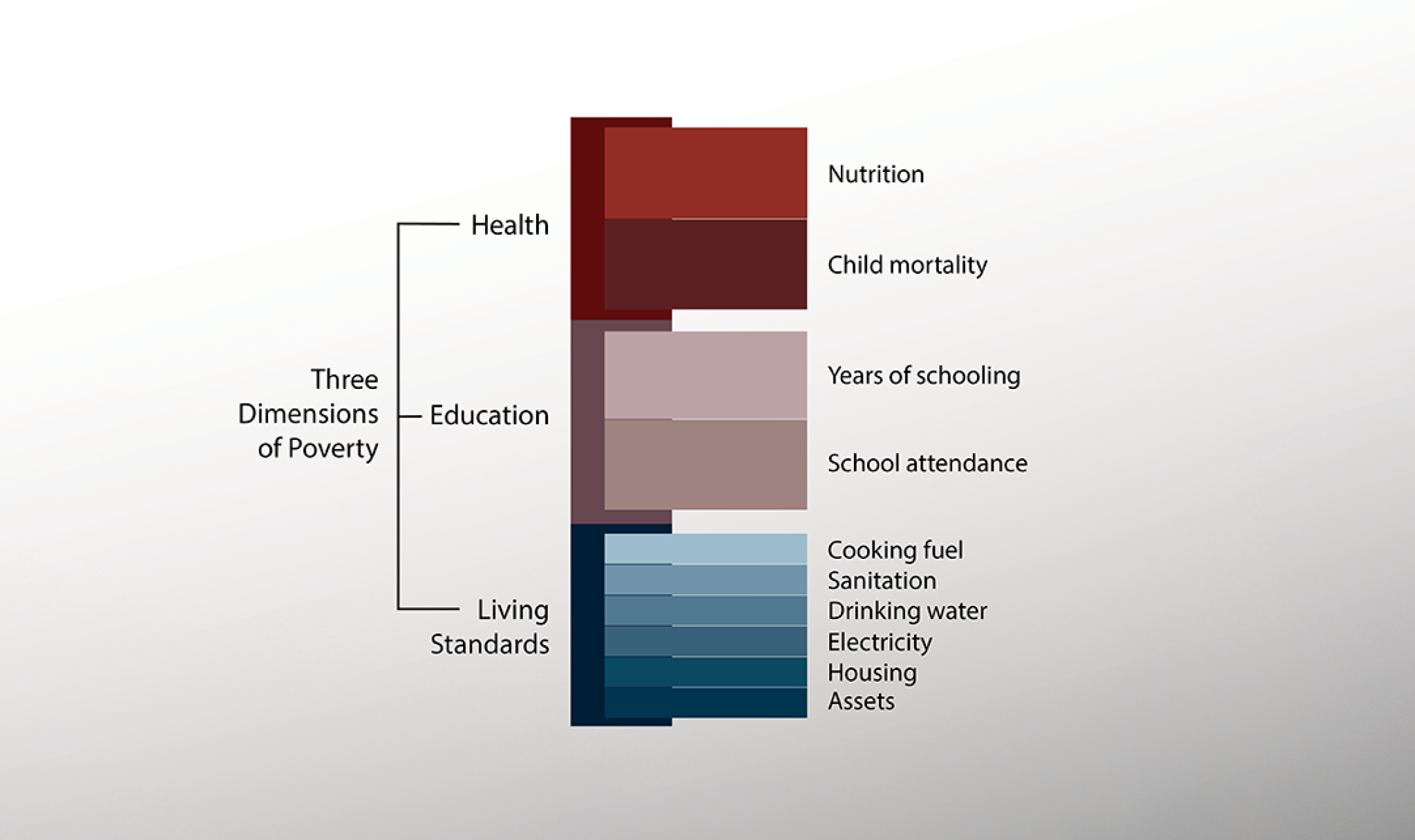
Multidimensional poverty is made up of several factors that constitute poor people’s experience of deprivation – such as poor health, lack of education, inadequate living standard, lack of income (as one of several factors considered), disempowerment, poor quality of work and threat from violence.

A multidimensional measure can incorporate a range of indicators to capture the complexity of poverty and better inform policies to relieve it. Different indicators can be chosen appropriate to the society and situation.

Why use a multidimensional approach?

  • Income alone can miss a lot. For example, economic growth has been strong in India in recent years. In contrast, the prevalence of child malnutrition has remained at nearly 50 per cent, which is among the highest rates worldwide (Citizens’ Initiative for the Rights of Children Under Six. 2006. Focus on Children Under Five (FOCUS).New Delhi: Secretariat of the Right to Food Campaign). Multidimensional measures can complement income.
  • Poor people themselves describe their experience of poverty as multidimensional. Participatory exercises reveal that poor people describe ill-being to include poor health, nutrition, lack of adequate sanitation and clean water, social exclusion, low education, bad housing conditions, violence, shame, disempowerment and much more.
  • The more policy-relevant information available on poverty, the better-equipped policy makers will be to reduce it. For example, an area in which most people are deprived in education is going to require a different poverty reduction strategy to an area where most people are deprived in housing conditions.
  • Some methods for multidimensional measurement, such as the OPHI-developed Alkire Foster method, can be used for additional purposes. In addition to measuring poverty and wellbeing, OPHI’s method can be adapted to target services and conditional cash transfers or to monitor the performance of programmes.
Share and Enjoy:
  • Print this article!
  • Digg
  • Sphinn
  • del.icio.us
  • Facebook
  • Mixx
  • Google Bookmarks
  • Twitter
 |  Trackback

Mapping the MPI

Multidimensional poverty index - mapping the MPI
Explore global multidimensional poverty around the world using OPHI’s mapping tools

MPI Country Briefings

Multidimensional poverty index - country briefings
Short country-specific summaries on the results of the MPI analyses in 104 developing nations

MPI Data

All the data from the global MPI, including detailed results at the national and sub-national level

MPI Resources

Multidimensional poverty index - Latest resources
All the global MPI publications, including briefings, working papers and training materials

MPI Methodology

MPI methodology
Details of how the global MPI is constructed and the updates that have taken place

MPI FAQs

Multidimensional poverty index - faqs
Everything you need to know about the global MPI, including how it’s constructed and how it adds value

MPI Case Studies

Multidimensional poverty index - case studies
Watch and read the stories of people who are poor according to the MPI in their country

MPI Podcasts

Multidimensional poverty index - interviews
Interviews with leading academics  about the global MPI and poverty measurement issues more widely