
Global Multidimensional Poverty Index
Click here to see all the analyses from the global MPI 2013, including:
~ Key findings from the global MPI 2013 ~
~ How multidimensional poverty has changed over time ~
~ Multidimensional poverty reduction in India ~
~ Identifying the world’s poorest billion people ~
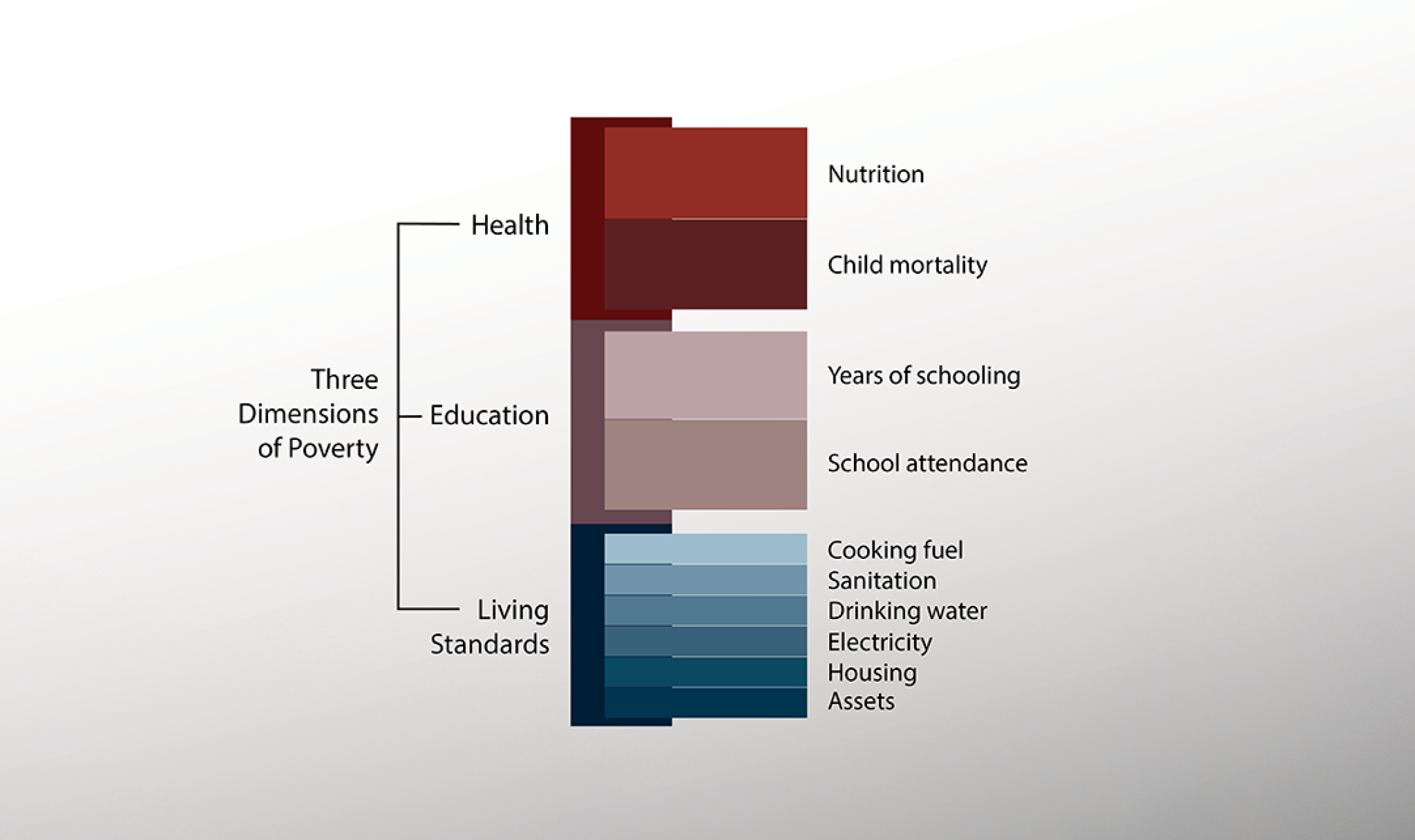
What is the global MPI? The global Multidimensional Poverty Index (MPI) is an international measure of acute poverty covering over 100 developing countries. It complements traditional income-based poverty measures by capturing the severe deprivations that each person faces at the same time with respect to education, health and living standards.
The MPI assesses poverty at the individual level. If someone is deprived in a third or more of ten (weighted) indicators (see left), the global index identifies them as ‘MPI poor’, and the extent – or intensity – of their poverty is measured by the number of deprivations they are experiencing.
The MPI can be used to create a comprehensive picture of people living in poverty, and permits comparisons both across countries, regions and the world and within countries by ethnic group, urban/rural location, as well as other key household and community characteristics.
This makes it invaluable as an analytical tool to identify the most vulnerable people – the poorest among the poor, revealing poverty patterns within countries and over time, enabling policy makers to target resources and design policies more effectively.
The global MPI was developed by OPHI with the UN Development Programme (UNDP) for inclusion in UNDP’s flagship Human Development Report in 2010. It has been published in the HDR ever since.
Find out more
MPI FAQs: Everything you need to know about the MPI
National and regional MPIs: Find out how countries are implementing their own MPI measures
Why multidimensional poverty measures? Conceptual arguments, public debates and challenges
The Alkire Foster method Find out about the counting approach used to construct the MPI
History of the MPI How the global MPI was developed for UNDP’s Human Development Report in 2010